
Features

Stolt Aspiration / Thorngarth

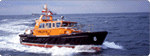
MT STOLT ASPIRATION / TUG THORNGARTH

MAIB REPORT

A consequence of changes to traditional tug operations has introduced new challenges for both tug masters and pilots. The increasing popularity of Azimuth Stern Drive (ASD) tugs has introduced a particular handling change since most of these tugs are designed with a bow towing winch resulting in towage over the bow. When on the stern or operating in the push/pull mode this does not cause too many problems but if required to operate on a centre lead the operation has increased risks of which pilots should be fully aware. On page 13 there is a review of the a monograph on this mode of towage published by the Nautical Institute and I would recommend that all pilots operating with tugs in this mode read this book in order to be aware of the risks and if possible also hold liaison meetings with the tug masters. When things go wrong operating in this mode the tug can rapidly lose control and the following is an edited extract from an MAIB report into one such incident.

Link to the original illustrated articlae (page 10):

pilotmag.co.uk/userfiles/Pilotmag%20285%20(Apr%2006).pdf

Stolt Aspiration, a 7901gt chemical tanker was bound for East Lewis Quay, Birkenhead. Entrance to the Birkenhead Docks is through the Alfred Lock The master and pilot had discussed the passage plan, and the pilot had signed the ship’s information sheet. Thorngarth, a Twin Azimuth Stern Drive (TASD) tug of 45t bollard pull, had been tasked with assisting Stolt Aspiration along with the tug Ashgarth. Both Thorngarth and Ashgarth were TASD tugs and towed over the bow. The two tug masters agreed that Thorngarth would act as the bow tug during the planned operation. Neither tug had any mechanical defects. As Stolt Aspiration approached Alfred Lock, the pilot began reducing speed steadily from 10 knots. The master of Thorngarth requested that Stolt Aspiration proceed at slow speed to allow the connection of the forward towline and, as this was normal practice, the pilot agreed. As the tugs approached, the pilot noted his speed through the water as 6.5 knots and slowing. Ashgarth reported that his line was being made fast and that he was happy with the speed. Thorngarth then began to make his approach. Because Thorngarth is designed to pass its towline from its bow, the tug had to approach Stolt Aspiration bow-to-bow, then manoeuvre stern-first to maintain the correct station off the larger vessel. The pilot was unhappy with the speed of Thorngarth’s approach, and warned the tug master. The tug slowed and the approach continued. Thereafter, Stolt Aspiration maintained a steady course, with the speed continuing to slowly reduce. Having received a heaving line from Stolt Aspiration, and having positioned close under the ship’s bow, Thorngarth backed away from her. The tug’s stern began to move to port, and this was corrected to maintain its position right ahead of the ship. However, the tug’s stern began to move to port again, which caused Thorngarth to move quickly across to the starboard side of Stolt Aspiration’s bow which, at this stage, was approximately 6 metres away from the tug. The tug master again attempted to position Thorngarth directly ahead of Stolt Aspiration’s bow, but this time, the corrective action caused the tug to move directly into the path of the vessel’s bulbous bow. Stolt Aspiration struck Thorngarth on its starboard side, causing the tug to heel heavily to port while being bodily displaced to port by the impact. On Stolt Aspiration, the pilot, noting the movement of Thorngarth’s masthead light, immediately ordered full astern, and used the bow thruster to counter the transverse thrust of the propellers and to maintain the vessel’s heading. Ashgarth also began to pull directly astern at full power to slow the ship. Thorngarth managed to pull clear and since she could no longer assist the ship was released and the Stolt Aspiration resumed the berthing operation without further incident.

Findings

The master of the Thorngarth had been appointed to the tug 10 days before the accident and had never carried out this manoeuvre on this tug and, although as mate he had seen it done on tugs of similar configuration, he was not fully familiar with the manoeuvring characteristics of Thorngarth. The collision occurred when the tug

master was re-positioning his tug ahead of the ship In backing away from the ship’s bow, the stern of the tug began to move to port. To correct this, he pushed the port ahead-astern handle forward, which swung the stern back to starboard. However, this slowed the tug and it closed the ship. Engine speed was increased to regain position ahead of

the ship. Once ahead of the ship, the stern again moved to port and again the port ahead/astern control handle was pushed forward to correct the swing. Because Thorngarth was now to starboard of Stolt Aspiration’s bow, as speed reduced due to

the change in astern power, she ended up on the starboard bow of Stolt Aspiration.

In attempting to recover from this position, the tug master caused Thorngarth to move across the closing bow of Stolt Aspiration where he was hit on the starboard side.

Tug manoeuvring controls and their propulsion systems cover a wide spectrum and, even among tugs of the same type, the speed of reaction of the propulsion gear to a control input will vary. As a consequence, any tug master will need to spend time familiarising himself with the controls of a new tug, even if he is familiar with the propulsion type and control system. Although the change of personnel between different types of tug is a necessary part of the flexible operation of a tug fleet, doing so without extensive initial or ongoing familiarisation training, where the complexities and nuances of control of different tug types can be properly understood and practised by the personnel concerned, will inevitably increase the risk of mistakes being made during operational situations. It was assumed that by the time an individual qualified as master, he would have experienced every type of tug manoeuvre, and that this experience would have been overseen by at least one other experienced master. No records were kept to monitor the training and experience gained.

OTHER INCIDENTS

Two similar accidents occurred elsewhere within the UK, within 4 months of the

collision between Thorngarth and Stolt Aspiration. In the first, a tug was operating

as the stern tug in moving a ship astern. After being asked to pull the ship’s stern to

one side, the tug found it could not regain its original position, and collided with the

ship’s stern. The second incident occurred when a tug, acting as the bow tug in a

berthing operation, was manoeuvring to pass its towline to the ship. Once the line

had been passed to the ship, the tug intended to move ahead of the ship, but collided with her bulbous bow. In neither case were there any injuries or pollution caused. In both cases, the tug masters had a wealth of experience in tug operations within their respective ports. However, both were operating tugs with unfamiliar propulsion systems and manoeuvring controls, and attempting manoeuvres with

which they were not entirely familiar. Safety issues identified as a result of the investigation.

1. Fatigue was not an issue in this accident.

2. There were no mechanical failures on either vessel that could have led to the collision.

3. The accident occurred when the tug master of Thorngarth was adjusting his position ahead of the ship and, due to his unfamiliarity with the tug, misjudged the amount of control movement required.

4. There was little that Stolt Aspiration’s crew could have done to prevent the collision.

5. Although the change of personnel from tug type to tug type is a necessary part of the flexible operation of a tug fleet, doing so without extensive initial or ongoing familiarisation training, where the complexities and nuances of control of different tug types can be properly understood and practised by the personnel concerned, will

inevitably increase the risk of mistakes being made during operational situations.

6. The bow-to-bow approach is conducted many times a day by tugs throughout the world.

7. No formal guidance was given to pilots concerning the capabilities and limitations of tugs in the port.

8. The introduction of new qualifications for Inshore Tug Operators has standardised the training requirements. The previous system was not satisfactory in that it relied on

personnel gaining the relevant experience over time but no records of experience gained were maintained.

9. The pilot and master of a ship would not know which type of tug has been allocated to the vessel until just before the planned operation. However, they could be confident that the tug would make the bollard pull requirement and would be capable of carrying out the designated task, despite not necessarily being the optimum choice of tug for the task.

10.There was no forum for the tug operators, pilots and port authority to raise matters of mutual concern.

11.By not informing the VTS operators of the accident, the VTS operators were unable to co-ordinate the response from the rescue services.

12.Two other accidents occurred elsewhere in the UK in a short period of time, both also caused when tug masters were operating tugs with unfamiliar propulsion systems and

manoeuvring controls, and attempting manoeuvres with which they were not entirely familiar.

RECOMMENDATIONS

The British Tug Owners Association is recommended to:

Encourage its members to ensure that the movement of personnel between tugs is

closely monitored, and that training and expertise of tugs’ crews are matched, and

are consistent with the type of tug and its expected task requirement.

Major Tug Operators, the British Tug Owners Association, and the PMSC Steering Group are jointly recommended to encourage regular formal discussion between port authorities, pilots and tug operators. All parties should be involved in the decision-making process, which will decide the optimum allocation of tugs for all manoeuvres within a port, and the level of crew experience required for each task.

118th Conference 2005

Conference 2005

The 118th Annual conference was hosted jointly by London and the Medway districts at the Village Hotel, Maidstone on the 11th -12th November. As usual there was a packed agenda to fill the two days and for those who were unable to attend the following is a brief resume of the proceedings. The full minutes are available for members upon request to the London office.


PNPF:

Richard Williamson, Boston

Following the now standard practice of holding a pre-conference pensions session Richard provided delegates with an overview of the PNPF activities since the 2004 conference. The primary change had been that there was now a requirement for trustees to be formally trained and this training requirement was being enhanced all the time.

The rest of Richard’s report was mainly based on the written report circulated to delegates and he covered the following topics:

PNPF Trust Company

Changes to Personnel

Membership: There had been a large reduction in retirements following a tightening of the ill health retirement rules which had brought them into line with industry norms. This had benefited the fund.

Review of the Equity Market

Investments and returns

Fund Value

Triennial Valuation

Having explained all the above with respect to the fund, Richard explained that although under the old Minimum Funding Requirement (MFR) the fund was fully funded, the triennial valuation now used a range of different parameters and this had indicated an on-going deficit. The PNPF was addressing this by:

Raising the retirement age from 60-65 (rather than raise contributions).

Adjusting the investment strategy which had resulted in 10% of the fund being invested in a “Hedge” fund managed by Goldman Sachs.

Had held discussions with the fund’s “Participating Bodies” and the UKMPA as to how to deal with the deficit.

Richard concluded his report by providing delegates with an explanation of Hedge funds and reassured the delegates that he was personally convinced that the fund would continue to provide on-going pensions to members.

OPENING SPEECH:

Michael Grey, Lloyd’s List

UKMPA Chairman Les Cate formally opened the conference and delegates observed one minute’s silence in memory of EMPA President Gianfranco Gasperini, IMPA President Hein Merhkens and past UKMPA president Sir James Callaghan, all of whom had died during the past year.  Michael Grey then opened the conference and in a lively speech explained how he used the many fora where he was invited to speak to explain the key role that pilots played in ensuring the safety of ships in port approaches. In particular he always reminded ship owners that if their vessel does suffer damage then they should compare the cost of pilotage to the cost of “lawyerage”!

Michael went on to express the concern that over zealous officials, the blame culture and the lack of respect shown to professionals such as Masters and pilots was causing young recruits to abandon a career at sea in an industry already suffering from an acute shortage of skilled professionals. He personally felt that the hope that technology would provide a solution was misguided since there was no alternative to “hands-on” experienced professionals although it was essential that pilots adopted and were trained in the use of any technology that would enhance safety.

Michael then formally opened the conference to warm applause from the delegates.

BUDGET REPORT AND FINANCIAL STATEMENT:

Treasurer: John Pretswell (Forth)

John opened by detailing the membership which currently stood at 486.

These figures represented a reduction of 7 since 2004. He then detailed the income and expenditure items for 2005 from which he had drawn up the budget proposals for 2006. Questions were asked about the legal expenditure which were passed to the Chairman who explained which elements had been funded by the T&G and which matters were being dealt with by the UKMPA through Blake Lapthorn Linnel (BLL) and Barrie Youde and he also explained the reason why the three different legal teams were engaged on the issues currently being dealt with.

DfT:

Phil Carey, Head of Ports Division

Phil provided a Power point presentation to the delegates whereby he explained the relationship between the MCA (executive agency of the DfT) and the DfT and how they worked together on matters such as maritime safety, navigation policy and the PMSC. This co-operation also included other bodies such as the General Lighthouse Authorities (GLAs).

EU DIRECTIVE: The UK Government had not welcomed the return of this Directive since in many ways it was a worse document than the earlier version that had been rejected in 2003.

PORTS POLICY REVIEW: This would be

getting under way early in 2006. The last policy review in 2000 acknowledged the principle of a market led port industry with the Government as regulator but the DfT needed to respond to new developments such as the reclassification of trust ports and the large increase in container movements. Small ports could be supported as part of local regeneration or, if no longer handling trade could be better used for redevelopment. The review would not commence until the outstanding container terminal planning applications had been dealt with early in 2006. Once the review commenced the UKMPA would be fully involved with the consultation in particular with respect to safety and security issues.  SECURITY: This was a separate issue with which the department was involved by ensuring that ports were up to date with security issues.

SAFETY: The UK had a good record on this but the review would be ensuring standards were implemented and this would require primary legislation. The Safer Ports Initiative where the DfT has been supported by the H&SE has achieved positive results above Government targets but there was no place for complacency.  PMSC: The MAIB had recommended that the DfT review the provision of powers necessary for the MCA to effectively monitor implementation and compliance with the Code and the DfT are currently complying with this recommendation.

INCIDENT MANAGEMENT: This was

another area of policy which was being dealt with by the Department following MAIB reports and procedures were being drawn up based on MAIB recommendations.

CHIRP: The DfT had confirmed funding for CHIRP for a further three years.

PILOTAGE: Two general items were outstanding and these were pilot boarding and the Working Time Directive.

NOS: The new shipping Minister, Dr.  Stephen Ladyman was actively supporting the maritime sector and promoting standards for shipping and the skills agenda.

PORT SAFETY BILL: Further to this the DfT were continuing to press for Parliamentary time to amend the Pilotage Act and to underpin the PMSC.

During the subsequent Q&A session Phil was able to clarify the many issues raised by his presentation.

MCA, MAIB & IMO:

Don Cockrill (London)

Don expressed frustration that after all the work on the PMSC, the only action taken in support of the Code by the DfT and MCA had been to produce the requirement for the CHA’s to submit a “Statement of Compliance” and it remained to be seen as to whether or not even this would result in improved compliance. From the experience of the areas in which he wasm involved Don was of the opinion that there was a deliberate policy of excluding pilots from the policy discussions by the ports and shipping industries.

Due to a shortage of time Don referred delegates to the written reports contained within the delegates conference pack.

LEGAL:

Fergus Whitty, Legal Director T&G

The theme for this year’s address to conference by Fergus Whitty was Age Discrimination, which was to be subject of the “Employment Equality Regulations” to be implemented in October 2006. After October 2006 any discrimination based on age would only be acceptable if it was justified and certain criteria and case histories for this were explained to the delegates.

Employers would in future have to specify a “Normal Retirement Age” (NRA) and there were procedures to be followed by both employers and employees with respect to this. The employer had to explain to an employee that they had the right to request to continue working after the NRA and once the new legislation was implemented the employee would have a right to “request” to stay on after the NRA and the employer would have a legal “duty to consider” such requests.

Q&A: In the ensuing Q&A session Fergus defined NRA as that determined by the employers pension fund. Also the legislation would not normally affect those pilots who were self employed unless they were operating under a contract to supply the service where advice would need to be sought.

Fergus also provided clarification over specifying age limits for certain jobs which used to be a common factor of pilotage.

This would be very difficult and if felt

necessary then the policy would need to

comply with the “justification”

requirements.

A point was made by Chris Hughes

(Europilots) concerning the fact that although self employed the conditions of his authorisation by Trinity House stated a maximum age of 67. How would the legislation affect this?

Fergus agreed that this was a very valid point which he would seek to clarify since the legislation would not appear to cover such an anomaly.

IMPA:

Nick Cutmore (Secretary IMPA)

Nick presented the report on behalf of Geoff Taylor who was unable to present the report in person due to illness.

Geoff’s report opened by paying tribute to Hein Mehrkens who had sadly died during 2005. As Senior Vice President Geoff had been nominated as Acting President to serve out the remaining term of Hein’s Presidency to November 2006 and he had been honoured to accept this.  Two key issues which IMPA were currently involved in were the EU Ports directive and also the ESMARALDA project which once again meant that arguments previously used in questioning bodies such as IALA over “Remote pilotage” would need to be revived to challenge the new phraseology of “remote access”. Denmark were seeking to make the Great Belt a compulsory pilotage area. The Danish Maritime Administration had requested support for the proposal for compulsory pilotage at IMO and had detailed the costs of pilotage against an exact breakdown of costs of a grounding of a tanker.

The matter of compulsory pilotage in the Torres Straits had caused some dilemma for IMPA in that the administration of the proposed pilotage service would be using competitive pilotage services which was against IMPA principles. Negotiations with Australia over this issue had been constructive and IMPA had finally agreed to support the motion.

IMPA had achieved a success in formally removing references to shore based pilotage from the IALA VTS manual. Geoff was pleased to report that IMPA membership was continuing to grow and it now had over 8,000 members. The finances were in good order but costs were high and pilots should all recognise that especially at IMO the IMPA representatives were dealing with many from the highest level of member Governments and were often pitched against other vested interests with very large budgets!

During the last year IMPA had had meetings with three different P&I Clubs and these had been very constructive for both sides. The Congress of Canadian pilots had been well attended by many influential international representatives.  Deep Sea pilotage was suffering on-going problems resulting from the competition between the groups. The report reminded all pilots that the next IMPA Congress would be in Cuba (November 2006) and it was to be hoped that as many members as possible would attend. The report was accepted by warm applause in recognition of the valuable work by Geoff in his absence.

TECHNICAL & TRAINING, ECTS,

MarNIS

An updated report is on p.9

PRESIDENT’S ADDRESS:

Lord Tony Berkeley

President Lord Tony Berkeley opened his speech by apologising for not having been able to attend day 1 of the conference. This had been due to his attendance at the Bilbao conference on ports, shipping and containerisation, followed by a visit to Brussels for a meeting with the Transport Commission to present a paper on future transport policy. This meeting had mainly dealt with maritime security. At present the way in which different sectors dealt with security was random and not always effective. Another point raised in the meeting was the expansion in growth in maritime trade. On the continent there was growing impetus to move traffic off the road and rail networks onto canals. In Lord Berkeley’s own field of rail transport discussions were taking place over the interdependency of transport and energy policies, in particular over coal. The result is that imports from deep sea were likely to remain steady or increase despite other sources of energy coming on line. There was a need for a Government led ports policy in order to ensure that the UK remained a base hub for shipping rather than become a feeder outpost from Europe.  The House of Lords had been attempting for several years to introduce an amendment to the Harbours Act to bring the planning procedures in line with those of roads. So far the attempts had been rejected by the commons but it was hoped that this time (3rd) it may be allowed to go through. Lord Berkeley concluded by paying tribute to the hard work and dedication by Les Cate and the Section Committee and pledged his continuing support of the UKMPA in highlighting the essential safety role played by pilots.

LEGAL:

Mark Foden, Blake Lapthorn Linnell (BLL)

Mark detailed the work undertaken by BLL on behalf of pilots during 2005. This included reviewing contracts for both employed and self employed pilots, unfair dismissal and with the London pilots advising on the proposed new arrangement for Local Navigation Certificates for watermen.

LIMITATION OF LIABILITY

Section 22(1) of the 1987 Pilotage Act had provided valuable protection for pilots and had thus kept the number of claims against them low. This legal protection was now being challenged and Mark was of the opinion that it was only a matter of time before a test case claim was made against an individual pilot. This section of the Act just covers civil liability for negligence but not criminal misconduct which is covered under Section 21.

In the case of a negligence claim against a pilot although 22(1) provides a maximum personal financial liability of £1000 the pilot would also be likely to have his authorisation suspended or removed and he would then be responsible for his own legal defence costs in fighting the suspension and potentially the costs of the claimant. The limitation also only applies when a pilot is undertaking his duties as a pilot. It does NOT apply to criminal cases which may be brought following an incident under the other Acts such as the Water Resources Act or if manslaughter charges are brought following a fatality in which a pilot may be implicated. It was for this reason that Mark was of the opinion that pilots needed to ensure that they had adequate insurance cover.

PROPOSED AMENDMENTS TO THE 1987 PILOTAGE ACT:

Joe Wilson (Tees), Barrie Youde,

(Solicitor, Hill Dickinson)

James Weedon (DfT)

Joe detailed the proposed amendments and new Sections that it was hoped could be included in a new Pilotage Act. The document provoked considerable discussion amongst the delegates and James Weedon (DfT) was able to clarify some of the points on procedure and Barrie Youde was able to clarify some of the legal phraseology and explain the legal reasoning behind some of the proposed amendments.  Following the discussion it was agreed that SC members would hold a meeting with the DfT on procedures and that the document would be placed on the members’ only section of the UKMPA website for members to consult and comment.

CHIRP:

Mike Powell (Director)

CHIRP had been subjected to several reviews by various departments during 2005 and this had delayed work on some investigations. The good news was that funding had been approved for a further three years. Since its inception, CHIRP had received 221 reports and about 100 of these had been progressed into action. About 70% were from the commercial merchant sector and the other 30% fishing and leisure. The “Maritime Feedback” newsletter now has a circulation of 140,000 and there was increasing interest from abroad where around 30,000 were currently sent to 47 countries. Mike detailed the many areas where CHIRP had been involved and he explained the processes which had resulted in changes being implemented by (sometimes reluctant) management. With respect to reports from pilots, reports concerning PEC issues had reduced but there were increasing reports concerning VTS. There had also been reports concerning the unfamiliarity and complexity of some new bridge equipment along with poor bridge team management problems and there had also been reports concerning fatigue induced by pilots’ rosters. During the subsequent discussion many different points were covered and Mike was able to clarify specific aspects of the CHIRP process to delegates.

MAIB:

Stephen Mayer (Chief Executive)

The MAIB investigated any accident involving a British registered vessel world wide and any accidents involving any vessel in UK waters. It was a totally independent body which meant that it was independent of the MCA, DfT, lawyers and vested interests within the maritime industry. The sole aim is to investigate the root cause of an accident and it was not the role of the MAIB to establish and apportion any blame. The outcome of investigations was to provide “lessons learned” in the hope that similar accidents can be avoided in the future.

The MAIB operates under the Merchant Shipping Act and the investigators have considerable powers which exceed those of the police and they can interview anyone, board vessels, enter property and seize documents in connection with an enquiry.  There is no right to silence and lawyers may be excluded. In return for these powers there is a strict confidentiality placed upon the investigation.

The MAIB is now receiving around 2500 accident reports per year and it decides which accidents should be investigated although the Secretary of State may request an investigation into an incident which the MAIB had decided not to. The benefits of an MAIB investigation over an internal HA or P&I investigation was that there was no vested interest in the outcome and therefore the recommendations were valuable in determining the effectiveness of existing legislation and helped to underpin proposed legislation and also identifying areas of concern which may currently lack legislation. The key areas of concern at the moment are:

Fishing: Statistically now the most dangerous profession and existing legislation is largely ineffective Leisure: Is unregulated

Commercial: Fatigue

This area of fatigue has been of great concern to the MAIB especially on the 2 watch system using the Master & Mate used on the short sea trade. The awareness campaign by the MAIB has resulted in the matter now being formally tabled for inclusion at IMO in 2006. The MAIB recommendation is for a minimum of 2 watch keepers in addition to the Master. Although there was widespread support for this there was a small group of opponents but the MAIB will not let the matter be sidelined.  This positive action was applauded by the delegates. In addition to fatigue the second key area of concern was complacency and the MAIB found it regrettable that there were still far too many accidents resulting from complacent attitudes by Masters.  Stephen concluded his presentation by explaining that accidents usually resulted from a failure of more than one element of safety and provided some graphic examples which revealed such failures which could have been avoided by an awareness of risk through formal risk assessments by the bridge team.

INSURANCES:

Paul Haysom, Ken Pound, Drew Smith

Following the withdrawal of cover by Navigators & General in 2004, Paul Haysom had arranged for a provisional policy with Royal & Sun Alliance (RSA) to cover members during 2005. A change in rules by the Financial Services Authority (FSA) meant that the UKMPA could no longer provide a ‘group’ policy but a similar policy with extended provisions had been arranged with RSA which offered a discount on premiums for members but in future each individual would be individually named. For this reason and also for the convenience of submitting the premium for tax relief it had been decided to separate the insurance premiums from the general subscription.

The topic of insurances generated considerable debate amongst the delegates and the Drew Smith (Circle Insurance) and Ken Pound (Ropners) were able to answer the main points. The new policy now covers a member from the commencement of the pilotage act until the completion and also provides cover against pollution incidents. Two cover options are available for £250,000 and £500,000 and individual members are free to choose whichever cover they prefer.

In answer to the question as to whether or not the RSA policy was necessary, the Section Committee had examined and discussed this in detail, in particular with respect to employed pilots, prior to recommending it for a conference vote. The argument that an employed pilot was covered by his HA’s insurance had been proven not to be the case and with the growing ‘blame culture’ and evidence that the validity of £1000 limitation of liability under the Pilotage Act may be subjected to a legal challenge the Section Committee were in agreement that additional cover was essential for all pilots. Following the discussion the adoption of the new policy and the separation of the insurance premiums from the general subscription was put to a vote where the proposal was carried by 45 votes in favour, 10 abstentions and no votes against.

Since the conference it has been confirmed that all members will receive an individual policy and tax receipt for their premium payment.

BELFAST:

Liam Magee

Liam updated the delegates on the latest news of the Belfast pilots’ dispute with the Belfast Harbour management. He thanked the UKMPA and T&G for the valuable assistance which had been offered so far and explained that he had been a member of NUMAST for many years and having only recently become a UKMPA member could appreciate the considerable benefits of UKMPA membership for pilots over NUMAST.

KRISTIAN PEDERSON:

Dave Devey

Dave explained to delegates the arguments that ABP had used to dismiss Kristian for “gross misconduct”. At a preliminary hearing the T&G lawyer had managed to provide the all the relevant facts in support of Kristian and the outcome was that the adjudicator had referred the case to a full tribunal hearing. Having been involved in the Humber, Belfast and SE Wales cases Dave had noted that these disputes were all inter related and warned delegates that it was necessary for all UKMPA members to fully support those affected.

HUMBER:

Dave Devey

The Humber issue was still very much “alive” and the Misfeasance in Public Office case was proceeding with the support of Hill Dickenson and a top QC.  Developments in this case were expected during 2006.

Parliamentary Questions

Lord Tony Berkeley has asked two Parliamentary questions. The First concerned NOS for pilots and the reply from Lord Davies of Oldham had stated that NOS had been adopted by many CHAs but he went on to add that the MCA “has been actively engaged in work on translating the NOS into an underpinning national qualification with Port Skills and Safety Ltd. (PSSL) and anticipate completing a port marine foundation degree framework in Spring 2006.

The NOS agenda is seemingly being driven by PSSL and other bodies which have excluded the UKMPA from participating and I am seeking clarification from the DfT over the policy and explaining the necessity of pilots to be involved in matters which directly affected them.

The second question asked was a result of the situation at Belfast whereby a consultant had arranged for the South Tyneside Maritime College to create a simulation of Belfast, in order to train up PEC holders to operate as pilots should the existing pilots decide to take industrial action over their current dispute with management over a change in their working agreement.

Lord Berkeley asked: “Whether the use

of a simulator at South Shields Maritime College to train marine pilots to operate in Belfast will enable them to become fully qualified to pilot ships there and, if not, for how long these pilots will be required to train in Belfast in order to gain the statutory local knowledge required by the Pilotage Act 1987 and to comply with the requirements of the PMSC and the recommendations of IMO resolution A960.”

Lord Davies replied: “It is for the CHA

to determine the qualifications and experience required of maritime pilots in Belfast, including the local knowledge component required by the Act, Code and IMO Resolution. The MCA has received a statement of compliance with the PMSC from the Belfast Harbour Commission and this assurance includes pilotage matters.”

Whilst the answer had been predictable this PMQ had been tabled in order to ensure that ports were aware that their compliance with the 1987 Act, PMSC and IMO 960 was being monitored at Government level.

1987 Pilotage Act

The UKMPA’s proposed amendments to the Act have been submitted to James Weedon (Policy Advisor Ports Division) of the DfT.  A “scoping paper” would now be presented to the Ports Division and if accepted would form a new Port Safety Bill.  The UKMPA team working on the amendments are: Joe Wilson, Dave Devey and Barrie Youde.

Legal

Blake Lapthorn Lovell was representing several pilotage districts. The cost of up to two hours for each district has been met by the T&G but any time over that is charged to the UKMPA and during the past year those legal costs had been considerable.

Europe

The Ports Directive was finally rejected on 18th January by a vote of MEPs by the following voting:

532 against - 120 for - 25 abstentions In the plenary there were calls for starting from scratch with a new white paper on Ports. Alternatively, the Services Directive that will be discussed next month in the parliament could call for Transport to be included in it. It will not go away it would seem.

I am pleased to tell you that the ESMERALDA document has not been accepted by the EU. Rumour has it that a new Ports document has surfaced called EFFORT written by a Professor from a Technical College in Hamburg that will be presented to the EU. When we are able to locate a copy it will be circulated to the Districts.

Thanks to those pilots who contacted their MEPs. Pilotage was mentioned by MEPs from the NW, Tees, London and Southampton. All sang from the same hymn sheet namely: competition in a safety service such as pilotage was dangerous.

Les Cate

Stolt Tern Grounding

STOLT TERN

I have decided to make the MAIB report into the grounding of the Stolt Tern the feature subject this quarter because the report covers many of the issues currently high on the UKMPA agenda. The grounding occurred in daylight and near perfect conditions and the pilotage was undertaken by an experienced pilot who had piloted this vessel and her sister ships many times to the same berth. The incident thus confirms that no matter how many times a pilot has undertaken a particular passage, pilotage is never

Link to the original pdf illustrated article:

pilotmag.co.uk/userfiles/Pilotmag%20283%20(Oct%2005).pdf

“routine” and pilots have to be permanently vigilant and be prepared for the unexpected. Only high quality training can help to prepare a pilot to cope with the unexpected.

The pilot and master both exchanged information in accordance with current “best practice” but the pilot’s passage plan is criticised in the report for not being sufficiently detailed in providing clearances from the breakwater and tracks to the

berth. I must admit that I disagree with this criticism because one of the primary roles

of a pilot is to be able to have flexibility during a passage rather than running on fixed tracks and if he has been trained professionally his detailed knowledge of the district permits him to know where the ship can and cannot be positioned depending on the vessel’s draft with respect to the height of tide. Pilots have to deviate from the “track” to facilitate overtaking or collision avoidance and in my experience the presence of a fixed track on a passage plan can cause more problems than it can potentially resolve in that deviation from a rigid track will cause the OOW to be constantly questioning the pilot and introduce doubt, confusion and distraction within the “bridge team”. Those who pilot warships will be only too aware of this! I feel that “best practice” would be that if the pilot is to depart from a “normal” track then he should inform the master of the reason and provide details of the height of tide in relation to the draft and provide the minimum UKC to be anticipated during the deviation. In this way the “bridge team” (as much as it exists in reality!) will be reassured and the OOW can, if he wishes, double check the calculations. Many vessels now shade-in shallow areas on the chart where the vessel should not navigate and this is considered good practice by

inspectors. Unfortunately, such shading is usually based on chart datum and takes no account of tidal height. For many tidal restricted vessels the whole piloted passage

can be undertaken through these shaded “no go” areas! Practically, it would be impossible to produce a passage plan shading in the actual no go areas unless the

vessel was fitted with an advanced ECDIS incorporating “real time” tidal data corrected for any tidal surges or cuts in tidal level. To the best of my knowledge such real time tide (and in Australia swell) corrected ECDIS is limited to a few specialist, port specific portable pilotage laptop units. Once things start to go wrong the Master pilot relationship is critical and unless both the Master and the pilot realise that the plan is unravelling and, more importantly, are in agreement as to how the situation can best be resolved then an incident is almost inevitable. One common factor in all pilotage related incidents is the rapidity with which a routine passage or manoeuvre transforms into a disaster. In this case it appears that the approach went from normal into a grounding scenario within 2-3 minutes. The reason on this occasion appears to be that the Master over ruled the pilot by reducing speed to less than that ordered by the pilot and used the bow thruster without being instructed. I believe that in this case, even if a “safe” track had been placed on the chart, the grounding would still have occurred

because the master (being unfamiliar with the port) was obviously concerned that the

vessel was going too fast and not swinging to starboard fast enough and thus reduced

the pitch more than requested and then whacked the thruster to starboard. His actions were therefore entirely successful in achieving what he thought was required rather than what the pilot had requested!! This incident happened whilst the vessel was under pilotage and therefore the grounding will automatically be put down to “pilot error” by the insurers! (see p.14). The report highlights the need for pilots to be fully trained and recommends that ports fully support pilots by providing on-going professional development. Further to this, the report acknowledges the importance of pilots being subjected to National Occupational Standards. This is what the UKMPA have been trying to implement since the NOS document was produced in 2001 and hopefully the

recommendations of the MAIB will accelerate the conclusion of this work. Finally the MAIB measures Holyhead port’s compliance with the requirements of the Port Marine Safety Code and also for the first time refers to the “best practice” detailed in IMO resolution A960. This report therefore reinforces the arguments made by the UKMPA of the need to draw up a new Pilotage Act to incorporate the PMSC and pilots’ NOS.

The following is an edited version of the full MAIB report.

REPORT

At 0915 on 1 December 2004, Stolt Tern approached the pilot embarkation position off Holyhead with a cargo of 4000t of gas oil. On arrival on the bridge, information was exchanged between the master and the pilot. The pilot was given the ship’s pilot information card and supplementary information regarding her Becker rudder that reductions in speed should be made gradually and not when changing heading. The pilot gave the Master the port passage plan to the intended berth. The pilot advised the master to alter course to put the breakwater fine on the starboard bow and manual steering was selected.

The master controlled the pitch control lever, and the third officer was on the helm, except when relieved by the master to allow him to plot fixes on the paper chart.

The speed was reduced to slow ahead when about 5 cables from the breakwater. Soon after, the pilot advised a 10° alteration to starboard to aim towards a prominent chimney. The third officer applied 5° of starboard helm. The master also gave a short burst of the bow thruster to starboard, and reduced to dead slow ahead, in accordance with advice he thought the pilot had given.

The ship started to swing quickly to starboard. The pilot commented that the stern was being influenced by the tidal stream and ordered ‘midships’ followed by ‘steady’. As the third officer applied 20° of port helm, the pilot advised ‘hard to port’. Although 35° of port helm was applied, and the bow thruster was thrust to port, the ship continued to swing quickly to starboard.

Realising that the ship was swinging towards the breakwater, the pilot advised the master to ‘stop’ followed by ‘full astern’. The third officer responded by stating in Filipino that this action would accelerate the swing towards the breakwater end. Accordingly, the master increased to half ahead and increased the port helm to 65°. Moments later, at 0940, the ship grounded on a patch of shoal water to the south of the eastern end of the breakwater. Estimates of the speed of grounding range from 2 to 6 knots.

ACTION TAKEN FOLLOWING THE COLLISION AND DAMAGE

The vessel was re-floated with the assistance of the tug Afon Braint at 1120, and was secured alongside Terminal 4 at 1215. There was no pollution.

Following a temporary repair, the vessel sailed to Rotterdam for permanent repairs.

ENVIRONMENTAL CONDITIONS

The wind was south-east force 1-2, and the sea was calm. The predicted mean rate of the tidal stream in the position of tidal diamond ‘B’ was 102° at 0.5 knot.

RECORDED INFORMATION

The course recorder was found to be reading 10 minutes slow, and 10° low. The ship was fitted with a propeller pitch recorder, but this was not working. The port’s radar was operating but did not have a recording capability.

NAVIGATIONAL PUBLICATIONS AND PASSAGE PLANS

The chart in use for entry into the port was BA 2011, the largest scale chart available and generally corrected up to date The port passage plan did not show the intended routes to the port’s berths.

THE PILOT

The pilot was 65 years old and was raised in Holyhead. He had served on board deep-sea ships, and had been qualified as a master since 1966. From 1970, he worked onboard ferries operating out of Holyhead, where he held a PEC. He was promoted to Master in 1980 and served continuously in that role until 1993. After ceasing to be a ferry master, he remained employed in the port overseeing dredging operations, and as a standby pilot. He became the port’s principal pilot in 1999. He conducted between 150 and 200 pilotage acts each year. The pilot had not experienced any accidents or near accidents during his time in Holyhead, and the Port Authority had not received any adverse comments from third parties regarding his performance. He was well respected for his knowledge and shiphandling ability by the port’s senior management, and maintained a keen interest in the operations of the port and in 2002 had also suggested that a permanent navigation mark be placed to mark the shoal water to the south of the breakwater end. In addition to his pilotage duties, the pilot had also voluntarily assisted the harbourmaster in the oral examination of over one hundred PEC candidates. He was well rested when he arrived on board Stolt Tern.

Intentions

The pilot expected the ship to be set to the east by the tidal stream as she proceeded towards the harbour entrance. He estimated that the rate would be a maximum of between 2 and 3 knots, and anticipated this would cause the ship to pass between 1.5 and 2 cables off the breakwater end. The pilot was aware the ship might experience a turning moment to starboard when for a brief period, the stern would continue to be influenced by the tidal stream, whereas the bow would not, and had identified a need to ensure that the ship was on a steady course during this period.

Recollections

The pilot stated that he never advised ‘dead slow ahead’, or for the bow thruster to be used when initially altering course to starboard. After port helm was applied to steady the ship, the pilot remembers the ship being steady on course for about 2 minutes, and that it was not until the breakwater head was on the starboard beam, at a distance of between 1.5 and 2 cables - that the sheer to starboard developed. From where the pilot was standing, he could not see the CPP control lever, or ship speed indications, but could see rudder angle and propeller pitch repeaters. He was conscious of the master making adjustments to controls on the console.

PILOTS AND NAVIGATION SAFETY

When the pilot was retained as the port’s principal pilot in 1999, there was no formal process for the authorisation of pilots in place. His PEC was transferred to a pilot authorisation without an examination being conducted. During the pilot’s time in post no formal checks had been made on his performance. The pilot was not employed on board ships over 10000grt using the Aluminium jetty. Mersey pilots were employed on these ships because of their need for tug assistance, The port’s pilotage committee was chaired by the harbourmaster and comprised the port’s major users, including the pilot, and other interested bodies. The committee’s agenda typically included all aspects of the safety of navigation, and pilotage within the port.

PORT MARINE SAFETY CODE

The PMSC was developed by the Department for Transport and was implemented in December 2001. The code introduced the principle of a national standard for every aspect of port marine safety, and although the code was not mandatory, the Department for Transport expected every CHA to comply with its requirements. These included the completion of formal risk assessments of marine operations.

National Occupational Standards

In its review of the PMSC, published in November 2004, the

Department for Transport concluded that:

MCA should continue to engage with the industry on occupational standards until it is generally established that these underpin the recruitment and statutory authorisation of those key positions - this needs to include the promotion of formal training in assessment.

National occupational standards for pilots have been agreed and accredited with the QCA. However, the assessment criteria for their implementation have yet to be agreed.

IMO RESOLUTION A.960 - PILOT TRAINING

Resolution A.960(xxiii) contains recommendations on the training and authorisation of pilots, and recommends that harbour authorities should satisfy themselves that pilots continue to possess up to date knowledge (at intervals not exceeding 5 years) of local navigational issues, current regulations and any other specifically related local issues. It also states:

Every pilot should be trained in bridge resource management with an emphasis on the exchange of information that is essential to a safe transit. This training should include a requirement for the pilot to assess particular situations and to conduct an exchange of information with the master and/or officer in charge of the navigational watch. Maintaining an effective working relationship between the pilot and the bridge team in both routine and emergency conditions should be covered in training. Emergency conditions should include loss of steering, loss of propulsion, and failures of radar, vital systems and automation, in a narrow channel or fairway.

The harbourmaster of Holyhead was unaware of the content of Resolution A.960(xxiii).

LOSS OF CONTROL AND GROUNDING

After the pilot embarked in Stolt Tern, the initial passage towards the breakwater proceeded as planned. However, as a small alteration of course to starboard was made to the north of the breakwater, the turn could not be checked and the ship started to turn from a course of 139° at 0937, and grounded at 0940 on a heading of 232°. It is estimated that the ship’s mean ground speed during this period was between 3 and 4 knots. In the absence of any indication of a machinery malfunction or failure, the loss of control was probably due to one, or a combination, of several factors.

First, the time interval between the engine movements from half ahead to dead slow was short, and the resulting reduction in speed would have been quite rapid. Given that the ship was known to be extremely right-handed and that the pilot information card warned against reducing speed and changing heading at the same time, a sheer to starboard was a likely outcome.

Second, as Stolt Tern passed the end of the breakwater, her bow would have entered the still waters to the south, while her stern would have been set to the east by the tidal stream to the north of the breakwater. This would have exacerbated the ship’s turning moment, and her slow speed would have prolonged her exposure to this effect. Third, although the time the bow thruster was used at the start of the turn was stated by the master to have lasted only a few seconds, its use is likely to have had an influence given the ship’s slow speed. In conjunction with the 5° of starboard rudder, which according to the information in the pilot card equated to about 15° of conventional rudder, this could have induced a high rate of turn unless quickly checked.

It is impossible to determine if the grounding would have been avoided had the master followed the advice of the pilot and put the engines astern. The master’s decision to ignore this advice, and to increase speed and rudder, was based on his knowledge and experience of the ship’s manoeuvring characteristics. It is correctly the prerogative of the master to take such action, whenever he considers appropriate.

BRIDGE MANAGEMENT AND COMMUNICATION

Before entering Holyhead, relevant information had been passed between the pilot and the master.

However during the execution of the passage plan the pilot was not integrated into the bridge team. The master’s rapid reduction of speed, and his use of the bow thruster, resulted from poor communication between the master and the pilot. The pilot was not aware of the action taken because the master did not inform him. He was concentrating on conning the ship and did not monitor the master’s actions.

The pilot estimated the ship’s position and movement by eye. He did not ask for any of the additional information available to the bridge team, such as ranges by radar or speed over the ground, nor was any of this information offered.

The pilot was isolated from the decision-making process during the discussions between the master and third officer, in Filipino, immediately before the grounding. The integration of pilots into a bridge team is essential if passages in pilotage waters are to be conducted safely. On this occasion, it is not certain why the master reduced speed to dead slow. He was operating the CPP controls, and was aware of the ship’s handling characteristics. However, better teamwork and a more effective working relationship between the master and third officer, and the pilot, might have helped to recognise what was going wrong with the plan in sufficient time for corrective action to be taken.

It is understood that some of the larger ports arrange for their pilots to attend tailored bridge simulator courses as part of their ongoing professional development. Such training would probably be of benefit to all pilots.

PASSAGE PLANNING

The intended passing distance off the breakwater allowed insufficient sea room and time for corrective action to be taken. A similar accident could easily have occurred had the ship suffered a mechanical failure.

There was no reason why a greater clearance could not have been planned. However, the pilot had followed the intended route and passed the breakwater many times without incident, and it had become custom and practice.

Although the bridge team had produced a pilotage plan for entry into the port, the lack of tide tables indicates that the master was reliant on the services of the pilot for this information.

PORT SAFETY MANAGEMENT

In keeping with the Port Marine Safety Code, the port of Holyhead was operated under a safety management system. Assessments had been made of all identified risks related to marine activities, and these had been periodically reviewed.

The simple and cost free precaution of allowing a larger safety margin when passing the breakwater end was not identified. This was particularly relevant to the ships on passage from the pilot station to Terminal 4, which needed to make a large turn around the breakwater end. The precaution was probably not identified due to the fact that the entry to the port is relatively straightforward, there was no experience of previous accidents in this area, and the port’s management, which was very experienced in ship and port operations in Holyhead, was highly respectful of the pilot’s ability and experience. Risk assessment is a very useful tool to quantify and reduce risk through the identification and implementation of suitable control measures. However, unless the control measures themselves are regularly reviewed to ensure that the risks are being kept as low as reasonably practical, the effectiveness of the risk assessment process is diluted. Liaison with the persons providing the control measures is essential to achieve this.

PILOT AUTHORISATION AND PERFORMANCE MONITORING

Since the pilot had been in post, the port had improved and formalised its procedures for the authorisation of pilots. This was demonstrated by the authorisation procedure followed for the standby pilot, and the pilots employed from the Mersey. The requirements for PECs were also clearly defined. The authorisation of the pilot on board Stolt Tern pre-dated these procedures, and he had never undergone any formal assessment in his role. However, the harbourmaster had monitored the pilot’s performance by accompanying him on the occasional act of pilotage, and by witnessing his shiphandling from ashore.

Local navigational knowledge and shiphandling are obviously pivotal to a pilot’s performance but there are other areas in which a pilot must also be proficient. It is difficult for harbour authorities to effectively monitor performance in all aspects of a pilot’s work, but a requirement for all pilots to have a qualification based on national occupational standards would at least provide a reliable base from which to start.

ONBOARD PROCEDURES AND SAFETY MANAGEMENT

A number of departures from the company’s procedures and material deficiencies, with respect to navigation and bridge management, were evident on board Stolt Tern. These included: the lack of tide tables; the chart in use not being corrected up to date; the lack of a helmsman on the bridge; the lack of a bridge team brief prior to entering the port; the lack of assistance provided to the pilot in terms of his familiarisation with the bridge equipment and general support; the interchanging of the master and third officer on the helm; the use of Filipino rather than English just before the grounding; the misalignment of the course recorder; and the non-functioning of the propeller pitch recorder.

RECOMMENDATIONS

The BPA/UKMPG marine and pilotage group is recommended

to:

Highlight to members of the BPA and UKMPG the importance of reducing the level of risk identified to as low as reasonably practical when conducting risk assessments, and the importance of ensuring that the effectiveness of any resulting control measures is reviewed regularly.

Reinforce to the members of the BPA and UKMPG the need to ensure a meaningful exchange of information between pilots and masters rather than merely the completion of a checklist. Such exchanges should cover all relevant areas such as the vessel characteristics, bridge team organisation and duties.

The MCA is recommended to:

Expedite and resource, through the national occupational standards working group of the PMSC steering committee, the requirement for national occupational standards for pilots to be a prerequisite for their recruitment and statutory authorisation.

Stolt-Nielsen Transportation B.V. is recommended to:

Review its safety management and auditing processes with a view to improving the safety culture among its ships’ crews, and encouraging a more open reporting regime.

Expedite its programme of bridge resource management training for its masters within its European coastal fleet, and ensure that pilot integration is included in the course syllabus.

Full report available on the MAIB website:

www.maib.dft.gov.uk/cms_resources/StoltTern.pdf

JCB

Watchkeeper Fatigue

WATCHKEEPER FATIGUE

Although pilots in the UK frequently have antisocial shifts the issue of fatigue seems to be generally well managed (except perhaps on the Humber!) by rosters which have evolved over time in most ports to provide a compromise between productivity and adequate rest. This fact seems to be bourn out by investigations into pilotage incidents which have not identi.ed fatigue as a statistical cause. Further con.rmation is that fatigue has not been raised as an agenda issue at conference except in relation to verifying compliance with the Working Time Directive. Having made that statement it doesn’t mean that we should ignore the issue of fatigue since an increasing amount of research places pilots in the highest zone of those at risk from the cumulative effects of disruption to sleep patterns. These effects are mainly an enhanced risk of heart disease, obesity and depression. Regrettably, as we all know, these effects, coupled with the high stress levels associated with pilotage, have resulted in pilots suffering above average levels early retirement and premature death.

For many years pilots, whilst acknowledging that modern on-board equipment has made navigation in pilotage waters safer, have argued that compulsory pilotage should not be reduced because as new technology has been introduced the consequent reduction

in manning has more than cancelled out any safety advantages achieved by such technology. This argument has of course been fiercely opposed by the shipping

industry and some ports who always perceive compulsory pilotage as an expensive and outdated anachronism! However, the statistics cannot be disputed and fatigue amongst seafarers is now a major cause of groundings and collisions and at last there is a spotlight being shone upon shipboard practices which is revealing a murky world of

unethical practices which until now have prevented the reality of seafarer fatigue from being exposed to the public gaze. Much of the focusing of this spotlight has been undertaken by the MAIB who are to be congratulated in their persistence over the last few years in placing the issue on the agenda at maritime forums and this perseverance is now at last producing recognition that a serious problem exists.

The results of a specialist survey undertaken by the MAIB, in conjunction with Qinetiq Centre for Human Sciences, into the six on / six-off watch system operated by deck officers on many vessels make for frightening reading.

Such is the concern of the MAIB over this issue, they have taken the unprecedented step of including a special report on their survey in the Safety Digest 1/2005 One aspect of this survey looked in detail at 19 groundings where the on-board watch patterns were identi.ed and the statistics from those 19 groundings revealed two key facts:

·        68% of the vessels were operating a 2 watch system

·        100% of the groundings between 0000 - 0600 were on vessels operating a two watch system.

Using an assessment programme based on one used for aircrews the MAIB survey model analysed the typical working pattern of an officer on a 12-6 watch on a 2,000grt ship. Even when not subjected to extra duties in the off watch period the model indicated that “dangerous” levels of fatigue were reached after as little as two to three weeks.

The MAIB report states that the “…survey serves to reinforce the MAIB’s long-held belief that fatigue, brought on by minimal manning and arduous watchkeeping and operational routines, is endemic at sea, especially in the short sea trade”. The report also states that:

A number of the accidents in the study were caused as a direct result of a lone watchkeeper falling asleep, but fatigue was a factor in many more of them. Long before a watchkeeper has reached the stage where he cannot keep his eyes open, fatigue is affecting his performance. It can cause the following:

·        Inability to concentrate, including being less vigilant than usual

·        Diminished decision-making ability including:

·        Misjudging distance, speed, time etc

·        Overlooking information required for complex decisions

·        Failing to anticipate danger

·        Poor memory, including forgetting to complete a task or part of a task

·        Slow response, including responding slowly to normal, abnormal or emergency situations

·        Reduced competence in interpersonal dealings

·        Attitude change, including:

·        Being too willing to take risks

·        Displaying a “don’t care” attitude

·        Disregarding warning signs

The data used in the safety study, especially that associated with grounding accidents, indicated a strong link between fatigue and watchkeeping arrangements. In its “Lessons” summary the report includes the following two specific recommendations:

·        Minimum safe manning levels need to be increased so that each seagoing

vessel of over 500gt has at least a master and two bridge watchkeeping officers.

·        Masters and owners should ensure that a vessel does not leave harbour unless all the watchkeepers, including the master where appropriate, are well rested.

NUMAST has taken up the issue and been running a major campaign recently to highlight the problem. Further to data received from the MAIB survey, NUMAST are supporting research by Cardiff University’s centre for occupational and health psychology sponsored by the MCA and H&SE. This is a major survey which is due to be completed in September 2006 and is surveying seafarers in three sectors, deep sea, offshore and short sea.

THE EU WORKING TIME DIRECTIVE?

In order to address the problem of fatigue at sea the EU included seafarers in the WTD in July 2003. Despite much resistance from shipowners the directive rules that seafarers should work no more than 14 hours in any 24 with a maximum of 72 hours in any seven day period. They are entitled to 10 hours rest in any 24 hour period with rest of 77 hours in any seven day period. The rest period may be divided into two periods but must include at least one period of 6 hours and the interval between consecutive rest periods must be no longer than 14 hours.

Having worked the 12 -6 watch myself as Second Mate in the 1970’s for 4 -6 weeks at a stretch my observations are that these WTD working rules, if adhered to, would result in a reasonably safe watchkeeping regime. The problem is that the rules are not being adhered to and up until now no one has really shown any interest in enforcement. Indeed, evidence seems to indicate that whilst all companies now issue instructions to their Masters that working hours must be compliant with the WTD some companies unofficially, actively discourage the Master to actually follow the regulations. The compliance instructions obviously remove the potential for liability from the Owners but leave the Master literally between the rocks and a hard place! The Master is always under pressure to sail and regrettably there is evidence to support the claims that if a master delays his ship for the purposes of resting the crew he will rapidly be replaced by a Master who is prepared to interpret the regulations in a more “flexible” manner! From a practical point of view there are frequently pressures on berth availability which may force a master to sail anyway and anchoring is not really a solution since normally an anchor watch will need to be kept so the vessel might just as well be on passage.

There are of course exceptions and I have piloted many coasters where the owners request the master to ensure that the crew are sufficiently rested in accordance with regulations and will never query his decision to remain alongside a berth for rest. I have also piloted other small vessels where, although the vessel is not subject to compulsory pilotage a master has taken a pilot in order to catch up on rest for

himself. It is of course an appalling situation where such good practices are undermined by a significant number of operators who whilst writing instructions on compliance will penalise or threaten a master who actually seeks to operate within the law. The

situation is also not helped by the practice by some companies of offering the master additional payment for self piloting his vessel thus providing a financial incentive to

stay on the bridge although he may be dangerously fatigued. Most VTS centres will have records of desperate attempts to alert non-piloted vessels that are standing into danger. Although it is obvious that these navigational errors are a result of the master or

watchkeeper falling asleep there is always an excuse other than fatigue provided by the master and some of these can be very imaginative and occasionally amusing. Insects of various varieties and grades of malevolence are a popular reason for causing

distractions to the OOW but in all cases the watchkeeper is always effusive with thanks when alerted to the danger! Unfortunately

outside areas covered by VTS (and occasionally within) the OOW fails to awake and the results are yet another wreck on the coast or a collision. It is the investigations into these incidents that has revealed the problems of fatigue

INSPECTIONS & ISM

The point is often argued that vessels need to show records of compliance with the WTD as part of their ISM procedures and it is true that “official” records of inspections will reveal that vessels are complying with the WTD and that there is no problem.  How can this happen? Well, “flogging the log” is still a thriving practice and I have had masters admit to me that they keep one set of records for the inspectors and another for the office for the overtime! I have also heard a story of a company sending a computer program to cover shipboard ISM requirements and in the section for recording working hours, if hours in excess of those permitted by the WTD were entered, the program refused to accept “illegal” data and requested that the operator enter correct data!!

IS THE PROBLEM BEING EXAGGERATED?

The reason that a formal survey is being undertaken is a direct result of the hidden picture revealed by MAIB investigations.  A survey by NUMAST amongst its members, who one would expect to be working on fully compliant vessels, revealed the following statistics:

2% of masters and officers were clocking up 16 or more hours per

day

2.4% worked in excess of 100 hrs per week.

29% did not regularly obtain 10hrs rest in 24

12% failed to get at least 6 hrs unbroken rest in 24

27% worked 15 or more hours continuously

20% spent 4 or more hours on additional duties.

50% felt that their working hours presented a potential threat to their personal health and safety 30% felt that working hours presented a danger to safe operations on board.

Obviously, being statistics, these figures need to be put in context since they represent those who responded to the survey. NUMAST does not detail the respondents as a percentage of the membership but it is obvious that those who are working non compliant hours are more likely to respond than those who are on fully compliant vessels. Despite this the survey does reveal a disturbing picture of non compliance with the WTD and another important finding of the survey was that only 7% stated that their hours had reduced in the last 5 - 10 years where a massive 51% reported an increase in working hours over that period.

Could these results be put down to members disgruntled with their lot and therefore be unrepresentative?

The following represents the findings of a researcher who spent fourteen days on board a 3500dwt mini bulker, with only two watchkeepers, during which time the vessel visited ports in Holland, Sweden, Germany, Belgium and Portugal.

“Both men were working six hours on, six hours off on a four months-on/two months-off work/leave pattern. The standard working arrangement for the deck officers was therefore 12 hours a day, seven days a week for four months without a break.  Whilst such a working schedule appears patently excessive by onshore standards, 84 hours a week is actually very much the best case scenario for seafarers working a six-on/six-off two man watch.  The captain in particular would frequently work from the start to the finish of a port visit without sleep, a stretch of as long as 24 hours. With only two officers to cover a 24 hour watch there was no ‘slack’ in the system - if one of the officers was unfit to work the other officer was forced to cover, putting an immense burden of duty on both seafarers.’

The researcher said it was clear that excessive job demands had been woven into the culture onboard ship. The deck officers on the vessel were expected to work 12 hours a day - which failed to account for the fact that one or two hours of paperwork would routinely have to be done in supposedly ‘off-duty time.”

The study identified a number of factors which come together to make working on a mini-bulker particularly demanding:

·        Short port stays, leaving no time for rest or recovery before heading back out to sea

·        Frequent port visits

·        Changing cargo types placing extra demand on the crew to prepare the ship accordingly

·        Only two officers to cover a 24-hour watch

·        Longer pilotage

·        Unpredictability of tramping’ from port-to-port, which can be stressful and makes planning sleep and rest periods difficult

In terms of understanding seafarers fatigue, therefore, where working hours might often appear the obvious culprit a more sophisticated approach is required’ which sees excessive working hours as potentially symptomatic of a poor solution to the port versus-

sea ‘crewing conundrum’,” the report concluded. As the researcher left the ship at the end of the study, the master appealed to him to highlight their conditions. “Something’s going wrong,” were his parting words.

SHOULD PORTS BE INVOLVED IN THE DEBATE?

The ports are obviously reluctant to become involved in this issue.  Already, the owners of small vessels feel port charges such as pilotage more than larger vessels and ports have addressed this either by subsidising the charges applicable to small vessels from the revenue obtained from the larger vessels or by excluding small vessels from compulsory pilotage altogether. Regular traders will usually be issued with a pilotage exemption certi.cate. The factor of fatigue is not addressed because if the master declares compliance with international and local regulations then the attitude is that the vessel will be manned in accordance with regulations so fatigue management is a matter for the Master and therefore not relevant to a vessel’s visit to the port. But, is this a neat excuse for avoiding the issue? Under the UK’s Harbours Act a Harbour Authority has a “duty of care” to all shipping and infrastructure within its jurisdiction. Despite the fact that a Master may declare that his vessel is compliant with WTD regulations it may become evident that the vessel is in breach of the WTD. If we take the case of a two watch feeder containership, the master will normally keep the 6 -12 watch and if he is the only PEC holder for a port he will be required to be on the bridge at all times whilst in port limits. This vessel might report at the outer limits of a port at 0400 and berth at around 1000. Typically this class of vessel will turn around in about 5 hours so will leave around 1700 and therefore clear the port limits at around 2300. With both master and mate required for berthing and port work neither can possibly comply with the WTD and both will be fatigued. If the master fell asleep on the outward passage and the vessel ran aground or had a collision could he hold the port in any way liable because since the port’s records are capable of identifying a breach of the WTD could the port be found to have failed in its duty of care by permitting the vessel to sail? I would be interested to know the thoughts on this from any lawyers amongst you.

WHAT CAN PILOTS DO?

Whilst piloting a vessel, if a pilot becomes aware that fatigue may be a problem the pilot can be placed in an awkward position if the Master tells him in con.dence that he is suffering from fatigue.The Master/Pilot relationship could be weakened if the pilot immediately reports the fatigue to the Harbour Master but there is a duty to report the matter in the interests of safety. The port may .nd it impossible to take any action if the Harbour Master visits the vessel and the Master shows false documents indicating compliance with rest regulations. Likewise if the MCA are called to inspect the vessel, again the Master may be reluctant to reveal a true picture and have the vessel detained. In such a case the best solution would appear to be to obtain as many details as possible from the Master and report the matter to CHIRP. By using the RISAP inter pilot reporting facility other ports can be alerted to the problem and if suf.cient data is obtained then the con.dential and anonymous CHIRP process would probably be able to confront the owners without jeopardising the Master’s position. In the case of exempt vessels the problem is more dif.cult but if a vessel appears to be displaying symptoms of being under the command of a fatigued PEC holder then the HM and the MCA should de.nitely be informed.

CONCLUSION

The fact that this issue is now receiving serious attention is welcome but it is not going to be easy to change the status quo and already pressure is growing to prevent the matter being raised at the IMO. The current situation is summarised in the following edited

extracts from a Lloyds List feature (2nd June) entitled “go on, stop on”

“There is no doubt in the minds of the MAIB inspectors who have ploughed through the causes of some 1,600 accidents over a 10-year period that “poor manning levels and fatigue were major causal factors in collisions and groundings”.

“It is an anachronism in the 21st century”, Admiral Stephen Meyer points out, “that seafarers are falsifying their timesheets to prove that they are working ONLY a 98-hour week. And many of these seafarers work every week, without a break, for between four and nine months before getting leave”.

There is equally no doubt that the operation of ships with a Master and mate alternating 6-hour watches is a recipe for disaster, even though it is a practice that has been widely used in the short sea trades, often, and illegally, without even a lookout during hours of darkness.

There is conclusive research to point to the rapid onset of fatigue aboard ships operated in such a fashion. There is, in fact, no reason for such a way of working to be perpetuated, and the MAIB has made it clear that it considers this way of ship operation is downright dangerous.

It is also interesting to note that the MAIB is regarded with great respect for its independence and could form a “model” for other casualty investigation systems in both European countries and elsewhere.

But issues of fatigue and manning levels cannot be confronted at a national level. The International Maritime Organization needs to take the matter forward as a matter of urgency.

Which makes it quite mysterious that a UK paper on this subject, in which the MAIB research featured largely as evidence, was withdrawn at the last minute from discussion at the recent Maritime Safety Committee, after pressure from the European Commission. That’s not a mystery, that’s a scandal.”

JCB


Lee, Martin

MARTIN LEE

Last “Grand Mat’’ of the AICH (UK branch)

View the original illustrated pdf article:

pilotmag.co.uk/userfiles/Pilotmag%20281%20(Apr%2005).pdf

It is with sadness that I have to report the passing away of retired Trinity House (latterly Medway) pilot Martin Lee. Many will remember Martin for his enthusiasm for the “wind ships”, one of the last of which was the Passat where Martin served much of his apprenticeship in the late 1940s. As one of a dwindling number of true “Cape Horners” who had sailed around Cape Horn in a commercial sailing ship not fitted with an engine Martin became the last “Grand Mat” of the UK branch of the L’Amicale Internationale des Capitaines au Long-Cours Cap Horniers (AICH) and had the sad task of formally winding up that Association as a result of the dwindling membership in 2003.

The evocative cartoon in the June 2004 edition of The Pilot concerning a sailing ship running at a fair speed into harbour is reminiscent of some of the manoeuvres which sailing ship masters, pilots and crews had to make in the 1930s and 1940s. Their vessels were all in the region of 3,500 to 5,000 tons deadweight, had no motive

power except their sails, no bow thrusts and two large (up to 3 tons) anchors forward. There were one or two exceptions such as the German four-masted barque Magdalene Vinnen / Kommodore Johnson (now the Russian Sedov) which, in those days had a small auxiliary diesel engine for helping in calm conditions but not much use for manoeuvring in any tide or breeze. Some vessels still had their stern anchor hawse-pipes and gear which had been used in Chilean and Peruvian anchorage ports. Erikson (Gustaf Erikson of Mariehamn in the Finnish Aland Islands) masters were

expected, like most Scandinavian masters, to avoid the use of expensive tugs when-ever possible. Incidentally G Erikson have recently sold their last reefer ship and are no longer ship owners in the accepted sense.

Pilots will readily understand the reference to a kick astern when there is no such thing available. Ports such as Port Lincoln, Wallaroo and Bunbury in Australia where ships berthed alongside were places where the master was expected to berth and unberth his ship unaided. I have a copy of the port charges for various Erikson vessels at Port Lincoln in the 1930s The four-masted barque Passat in February 1937 incurred a total of £299 13s 6d harbour dues including £63 pilotage, boatmen and mooring £12.

These charges were for berthing, shifting to and from the ballast grounds and sailing when loaded. There are no tug charges. These vessels had to have a minimum of 300 tons of solid ballast in port and over 1,300 tons for a deep sea voyage this stuff was manhandled by the crew and required shifting the ship with half the cargo loaded out to the ballast ground and dumping the material over the side before returning for cargo

completion. Berthing one of these ships required the right conditions and a great deal of skill and hard work, it could be lengthy business – it took us most of the day and a great deal of sweat and shouting to get the Passat alongside the long, winding jetty in Bunbury with no assistance. We had arrived on 4 September 1947 in ballast from East London. In East London we were head out on the south side of the Buffalo River and when the tug and pilot arrived there was an offshore breeze. Captain Hagerstrand was a man of few words, he never spoke to us in English but conversed well in that language with others; he also rarely swore. The date was 14 April 1947, I was standing by the big double wheels ready for action, the master said “we don’t need the tug, we will sail the ship out to sea.” As he spoke there was a rain squall and the wind shifted to a fresh on the berth breeze. The air then became blue with a mixture of Swedish, Finnish and English oaths – we had to take the tug to get us off the berth. The voyage was 4,331 miles in a time of 20 days 17 hours at an average speed of 8.7 knots, this compares favourably with tramp steamers making passages at 7 knots and consuming large amounts of fuel. On arrival off Bunbury the pilot came on board and said that the tug was away in Fremantle but we could use the local dredger to help us alongside. The master weighed it all up, we dropped the starboard anchor off the end of

the jetty, swung head to wind, the gallant dredger took a line aft and at the first tow pulled her bitts out of the deck. I did not hear any language from amidships but we eventually hove her alongside with hand capstans with no further assistance. We loaded a full cargo (4,700 tons) of jarrah wood railway sleepers for Port Swettenham (now Port Klang) in Malaya, the ship was down to her marks and we sailed on 17 October 1947 with a fair wind off the berth. We had mastheaded the upper tops’ls before sailing so a good spread of canvas was immediately available and sailed quietly away with no tug and no fuss. Mooring at a single buoy in Port Swettenham was a different story, we took two

harbour tugs. We then proceeded, with sand ballast, to Port Victoria in the Spencer Gulf in South Australia to load grain in the traditional manner. Arriving there on 2 March 1948 we found the four-masted barques Lawhill and Viking loading in Hardwicke Bay. Port Victoria is an anchorage port with poor holding ground,

some Erikson masters who had been in the trade for years, detested the place and wrote of the ‘merry-go-round’ of dragging anchors round the bay. We put two anchors down and kept good anchor watches, sometimes a spanker was set and a spring attached to the weather anchor to make a lee for the ketches bringing bagged barley out.

Sailing ships had larger anchors and cables, as required by the classification societies, but, without the benefit of a kick ahead. The shores of Wardang Island in Hardwicke Bay have the remnants of several square-riggers which did not survive the ‘merry-go-round’.

Large square-rigged ships loaded phosphates and guano in remote places such as Astove Island, Nosse Be and other delightful places in the 1920s and 1930s. There were no tugs available there and great skill was required to get these ships into position in a restricted area where there was sufficient depth for anchors to hold. The four-masted barque Olivebank was chartered to load guano for Auckland, at Assumption Island, N of Madagascar, in 1928. She shipped 84 men from Mahe to do the loading and anchored in 80 fathoms, a ship’s length off the island. Two days later her anchors slipped off the ledge into precipitous depths and it took her two weeks to get back and anchor in 12 fathoms forward and 84 fathoms aft with the vessel 80 metres off the land. Captain Troberg had had enough of guano sailing after this! When the Pamir was seized in Wellington in 1941 she had just arrived from Assumption. Two pilots had leapt on board as she approached in a southerly gale and sailed her through the narrow harbour entrance off Pencarrow – she stayed under the NZ flag for a further 8 years sailing across the Pacific to NW America and Canada, with one voyage to London in 1948.

As a River Medway (ex-Thames) pilot I sailed the replica Golden Hind from Upnor to Tower Pier in the 1970s. This was (is) a small ship, she had an underpowered engine set on the starboard side. We sailed up the Thames on a rising tide for an ETA at Tower Bridge and arrived on time with cannon blazing and under full sail. I had already explained to Captain Adrian Small (we had been apprentices together on the Passat) that the next bridge does not open. We still had a following wind and flood tide and there was much shouting as we rounded the Belfast with sails flogging and finally made our way to Tower Pier. As her temporary master and pilot we shifted her a few times in the Upper Pool (always in the middle of the night of course), she had been fitted with under water buoyancy bulges which were invisible from the deck. Making the entrance lock at St Catherine’s could be quite interesting; we actually sailed in stern first on one occasion as the wind was so strong from ahead.

In 1996 and 1997 after a change of direction from piloting to other matters I spent two hurricane seasons in the Caribbean as a master on the four-masted barquentine Star Clipper. This vessel and her sister ship Star Flyer were built in Belgium in the early 1990s, their hull size was similar to that of the German ‘P’ ships –

106m x 14.7m. There the similarity ends, they carry up to 174 passengers in five-star luxury, have two swimming pools a main engine and bow thrust and comply with the very strict USCG requirements for cruise ships as well as the myriad of other needs with strange labels. Their square sails on the fore-mast are controlled by a push-button system, eg ‘lower tops’l out and lower tops’l in’. A magic device that would have amazed any watchkeeper on a proper sailing vessel. Their rigging mistakes are the massive main and mizzen fisherman sails set high up. They have to come in quickly in squalls and often jam in their tracks causing heavy heeling and ominous crashes from the galley and bar.

We sailed whenever possible and carried out manoeuvres such as getting under way from an anchorage under sail alone, tacking, wearing, boxing and other crew heavy (assisted by passengers) work. She was not the easiest ship to handle with her windage

aloft and a not too powerful engine. We did manage a Mediterranean moor in St Georges when both berths were occupied, two anchors down and backed up to the space between the two ships putting crossed stern lines ashore. Approaching Castries (St. Lucia), after sending a